In all of knittingdom, there are only 2 stitches: The KNIT (K) stitch and the PURL (P) stitch.
(Well, perhaps there are 3? A yarn over (YO) is neither a knit nor a purl. On the other hand, a YO may not be a stitch at all, so maybe we are back to 2?)As soon as you master these 2 (3?) stitches, you can make anything at all in all of knitting; cables, picots, stockinette fabric, garter-stitch fabric, lace. This all seems simple, and, in a
zen-like sort of way, it is. However, the complications soon start cascading and obscuring all.
The first complication stems from the split between knitting's two main divisions: continental knitters who carry the working yarn on their left hands, and English knitters, who carry the yarn on their right hands.
Knitters argue about which method is "better."
Speed records are set by
both kinds of knitters. I believe the best way to knit is the way that you, personally, prefer. The next 4 posts will illustrate both continental and English knitting and purling--if you don't already know how to do these, you could try them and make up your own mind.
But before the how-to posts, THIS post is about how the continental style and English style differ, and why handedness (left-handed, right-handed) has only a little to do with which style will work better for YOU.
CONFUSION
There is a lot of confusion about the difference between continental and English knitting. For me, learning to knit continental arose from this confusion.
I did not learn to knit until I was 24 years old--old enough to get my own way with my very stubborn mother. Before that, my mother refused to teach me because she thought she would teach me the "wrong" way--the continental way--which
she had learned as a girl in Germany. She thought that I should learn "regular" (English) knitting so I could follow knitting patterns written in English--she thought continental knitting was "backwards" to English knitting.
My mom was confused (and did I mention? stubborn...). It is true that continental knitting and English knitting differ. However, the stitch which results--the loop on the needle--is the same (and the same knitting patterns work for both).
The difference between continental and English knitting arises ONLY from
which hand holds the working yarn. In continental knitting, the working yarn is held on the left hand, so that the tip of the right needle "picks" the yarn to draw it through the loop. In English knitting, the working yarn is held on the right hand, and the working yarn is "thrown" around the tip of the right needle, then drawn through the loop.
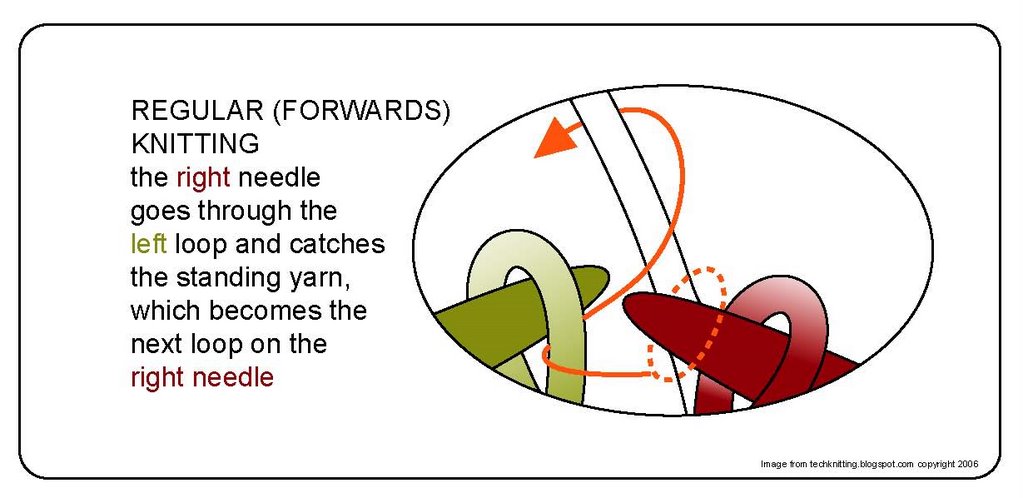
If you ignore the hands supplying the yarn and watch only the needles, the ACT of drawing a new loop through the old loop is the same in continental and in English knitting:
click picture
*the loop to be worked is held at the very tip of the
left needle
*the tip of the
right needle reaches through that loop, snags the standing yarn "up from under," and pulls that snag through the left loop.
*by this act, two things happen simultaneously: first, as the
right needle draws the snag through the left (old) loop, the snag enlarges to become a new loop, second, the new loop is transferred to the
right needle.
HANDEDNESS
Some think that continental and English knitting have to do with handedness--left handedness, right handedness. That's only partly correct.
click picture
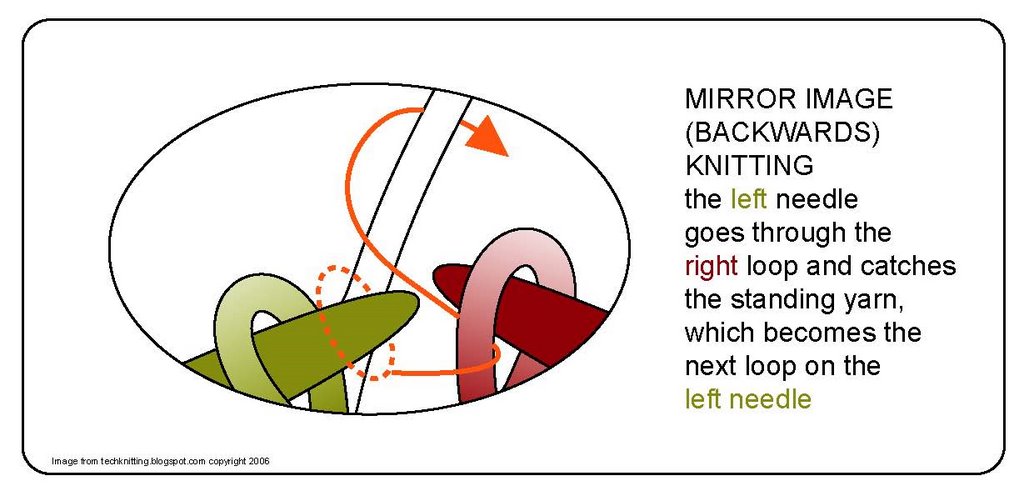
What some call "left- handed knitting" is actually BACKWARDS, a.k.a MIRROR-IMAGE knitting: using the
left needle to draw a new loop through a stitch on the tip of the
right needle. This transfers the new stitch onto the
left needle and generally leaves the new stitch oriented backwards--that is,
left arm forward. The act of supplying the yarn also changes hands, with the right hand carrying the standing yarn in continental knitting, and the left hand supplying the yarn in English knitting.
There are knitting teachers who go through a lot of trouble to teach the left handed to knit backwards--the most popular technique is to use a mirror. This approach probably stems from a time when there were fewer choices--
when people only knew about one way to knit--and presumably thought it self-evident that lefties should knit differently than righties.
I myself would avoid this approach. Knitting is (
usually, but not always) a two-handed activity--the right-handed have just as much trouble learning to control their left hands as the left-handed have controlling their rights, so the left-handed are (for once) at no disadvantage.
It may be that a left-handed person will be more comfortable with continental knitting--in that style the left hand gets to do more work than in English style. I'd certainly try that before I could be persuaded to teach even the most profoundly left-handed person to knit backwards.
Mirror-image knitters are doomed to a lifetime of transposing knitting patterns, not to mention confusing knitting teachers. Without transposing, mirror-image knitters' decreases and increases will slant the wrong way and everything'll be backwards--just what my mom feared when she (mistakenly) refused to teach me continental for fear that I'd never be able to follow a printed pattern.
To those of you who already knit mirror-image: you have my admiration for your perseverance and persistence in a knitting world which lies, for the most part,
sdrawkcab * to you. To those of you who are left handed and have yet to learn to knit: the best way, IMHO, would be to learn the same way as right-handers do--and try continental first.
(Added 2-8-07-- a new final conclusion: I myself have taught at least a half-dozen different left handed people to knit "regular" over the years. I also know several additional left handed people who knit continental with no problem. It was based on this experience that I wrote this post. HOWEVER...dear readers, I have just heard from Jenny, a left-handed reader who posted below. She has had a different experience--she tried to learn regular knitting--English AND continental, and she STILL found mirror image knitting easier. Evidently, sometimes a left-handed person has to choose between mirror image knitting or no knitting. In that case the choice is easy--knitting is SO obviously more fun than not-knitting! Bottom line: I would certainly try to teach a left handed person to knit "regular" and would concentrate on the continental style. BUT, if you try and try, dear lefty, and still can't knit, not even continental, then we'll all have to swallow the fact that you're going to have to learn to transpose patterns, and learn to knit mirror image....)--Techknitter
*("backwards," spelled backwards)